.png)
Why Exercise is Medicine...
Most people think of medicine as something you collect from a pharmacy.
A tablet to lower blood pressure.
An injection to control diabetes.
A prescription to relieve pain.
But one of the most powerful treatments available doesn't come in a bottle.
It comes from movement.
When healthcare professionals say "Exercise is Medicine," they don't simply mean exercise is good for you.
They mean that exercise changes the way your body functions at a biological level.
It influences your heart, brain, muscles, bones, immune system, hormones and metabolism—all at the same time.
In many cases, it can help prevent disease, slow disease progression and improve symptoms alongside medical treatment.
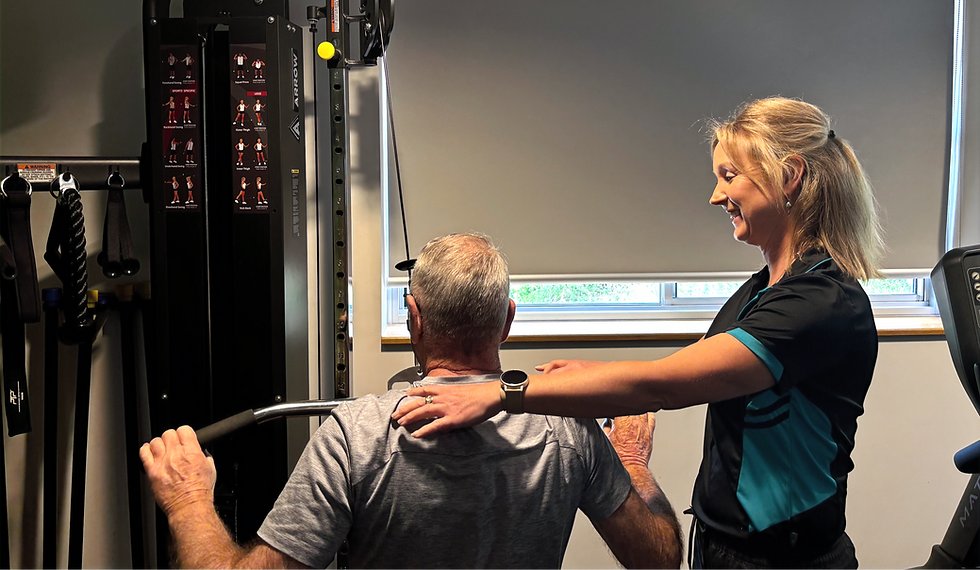
That's why Exercise Physiologists don't simply encourage people to "exercise more."
We prescribe exercise like medicine.
Every Medicine Has a Prescription
Think about the last medication your doctor prescribed.
They didn't simply tell you to "take some tablets."
They prescribed:
The right medication
The right dose
The right frequency
The right duration
The right person
Exercise works exactly the same way.
The exercise prescription for someone with osteoporosis is very different from the prescription for someone with Parkinson's disease.
Someone recovering from breast cancer needs a different program to someone managing persistent back pain.
The diagnosis changes.
The exercise changes.
That's what makes Exercise Physiology different from general fitness.
Your Muscles Do More Than Move You
One of the biggest discoveries in exercise science over the past decade is that muscles are far more than tissues that help us move.
Every time you exercise, your muscles release powerful chemical messengers called myokines.
These travel throughout your body, influencing your:
Brain
Heart
Bones
Liver
Immune system
Blood vessels
Fat tissue
Scientists now recognise skeletal muscle as one of the body's largest endocrine organs because of its ability to communicate with almost every other system in the body.
In simple terms...
Every time you move, your muscles are sending positive signals throughout your body.
Exercise isn't simply burning calories.
It's changing your biology.
One Treatment. Multiple Benefits.
Most medications are designed to target one condition.
Exercise is different.
Appropriately prescribed exercise can improve health across multiple body systems at the same time.
Research now supports exercise as an important part of managing more than 30 chronic health conditions, including:
Type 2 diabetes
Heart disease
Osteoarthritis
Osteoporosis
Persistent low back pain
Depression
Anxiety
Parkinson's disease
Many cancers before, during and after treatment
In many of these conditions, exercise is now recommended as a first-line treatment, alongside medical care—not simply something to try if everything else fails.
More Isn't Always Better
One of the biggest misconceptions is that if some exercise is good...
More must be better.
That's not how medicine works.
And it's not how exercise works either.
Too little exercise may not provide enough stimulus for your body to adapt.
Too much exercise may increase injury risk, delay recovery or worsen existing conditions.
The goal is finding the right dose for your body.
Just like medication, exercise works best when it's prescribed appropriately.
There Is No Such Thing as the "Best Exercise"
People often ask us:
"What's the best exercise for arthritis?"
"What's the best exercise for osteoporosis?"
"Should I be walking or swimming?"
The answer is...
It depends.
The best exercise is the one that targets the problem you're trying to solve.
For example:
Someone with osteoporosis needs exercises that place appropriate load through the skeleton to help maintain bone strength.
Someone with type 2 diabetes benefits from improving muscle mass and using exercise strategically to help manage blood glucose.
Someone with Parkinson's disease needs exercises that challenge balance, coordination, movement speed and dual-task performance.
Someone recovering from cancer may need to rebuild strength while carefully managing fatigue.
The diagnosis changes.
The exercise prescription changes.
That's why generic advice often falls short.
The Side Effects Are Pretty Impressive
Every medication comes with possible side effects.
Exercise has side effects too.
Fortunately, they're usually the ones we're hoping for.
Regular exercise can help:
Lower blood pressure
Improve blood sugar control
Increase muscle strength
Maintain bone density
Improve balance
Reduce falls risk
Improve sleep quality
Enhance memory and concentration
Reduce symptoms of anxiety and depression
Increase energy
Improve quality of life
It's difficult to think of another treatment that positively influences so many systems in the body at once.
Exercise Doesn't Have to Mean the Gym
Exercise isn't defined by where you do it.
It could be:
Walking
Resistance training
Swimming
Cycling
Pilates
Gardening
Playing with your grandchildren
Climbing stairs
Dancing
The important question isn't:
"What exercise should I do?"
It's:
"What does my body need?"
When exercise is prescribed to match your goals, health and lifestyle, it becomes far more effective.
The Future of Healthcare Is Moving More—But Moving Smarter
Healthcare is changing.
Increasingly, exercise is being recognised as an essential part of preventing and managing chronic disease—not as an optional extra, but as a core component of treatment.
That's why Exercise Physiologists work alongside GPs, specialists and other healthcare professionals to prescribe exercise safely and effectively for people with a wide range of medical conditions.
The Bottom Line
Exercise isn't simply about burning calories or improving fitness.
It's one of the few treatments that can improve your heart, brain, muscles, bones, metabolism, immune system and mental wellbeing—all at the same time.
At Body Concepts Exercise Physiology, we don't just help people become more active.
We prescribe the right exercise, at the right intensity, for the right condition and at the right stage of your health journey.
Because when exercise is prescribed properly...
It isn't just movement.
It's medicine.


Comments